
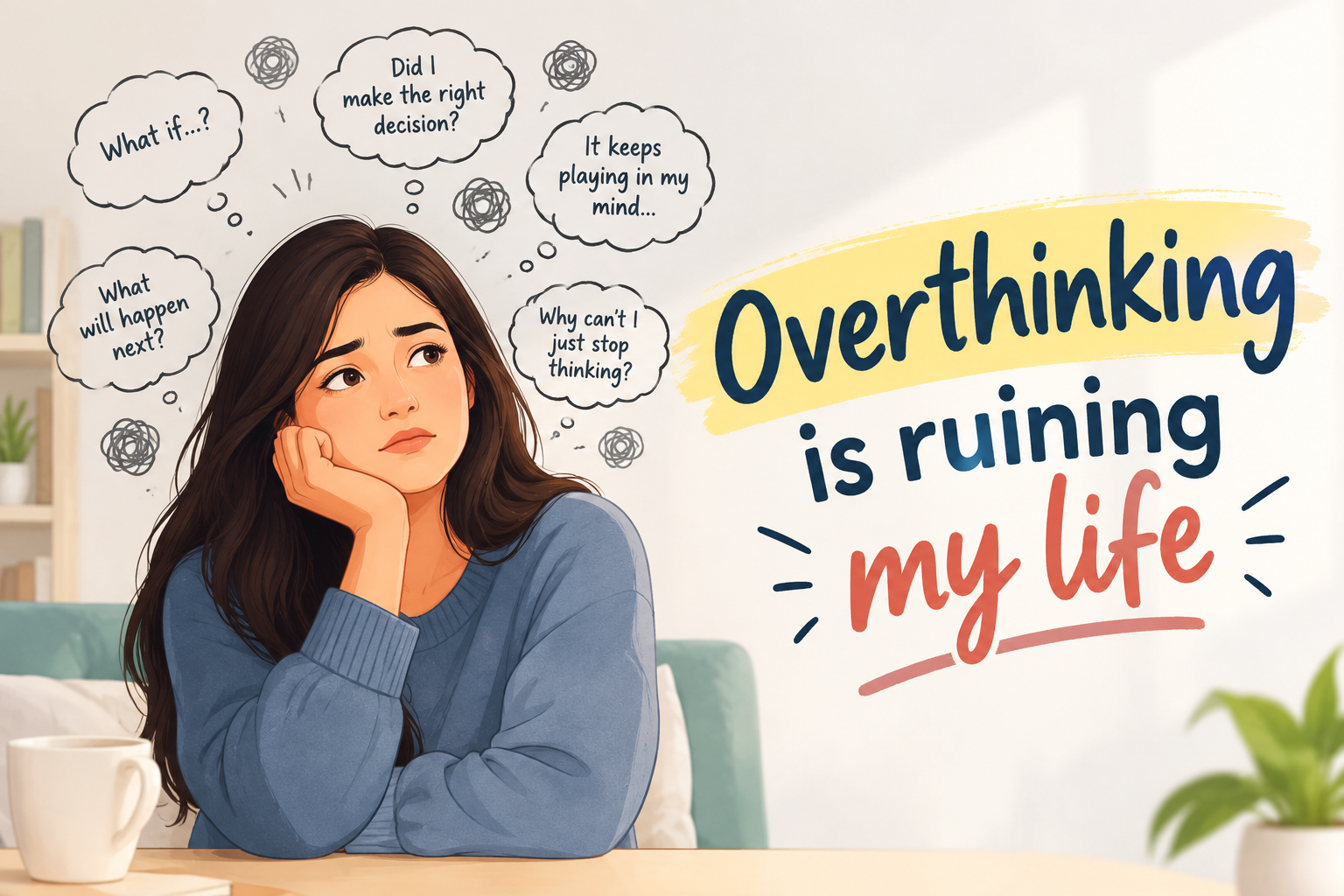
If you find yourself awake at 2:00 AM replaying a five-second moment from three days ago, or if you feel completely stuck because you can’t figure out the “right” choice, you know exactly how exhausting this is. Overthinking doesn’t feel like a bad habit. It feels like a full-time job that you never signed up for, and it drains your mental battery before your day even starts.
The hardest part? Your brain is tricking you into thinking worrying is productive. It makes you feel like if you just run through one more scenario in your mind, read one more article, analyze one more situation, you’ll finally feel safe or certain. Indeed, thinking about a problem forever is not the same as solving it. It just keeps you stuck.
The Four Mind Traps That Keep You Stuck
Overthinking rarely happens in isolation. It typically works through four particular loops of thought that feed on each other:
-
Analysis Paralysis: When you have too many choices or when you take in too much information that you cannot make a single decision. You do nothing. Because if you pick one path, you have to forsake all the others.
-
The Search for Absolute Certainty: Wanting 100% certainty that a decision will turn out well before making a move. But in life, you never have 100% certainty, so you get paralyzed.
-
Perfectionism: If you can’t do something perfectly, then it’s not worth doing at all. This makes beginning anything feel terrifying.
-
The Catch-22 Loop: You realize overthinking is ruining your life and begin overthinking how to stop overthinking. You look up how many tools there are, get overwhelmed by all the choices and give up.
What It Looks Like in Practice: Megha’s Story
Consider Megha’s experience as an example of how subtle and destructive this is.
Megha, who was 22, living at home, and utterly overwhelmed by the state of her daily life. Her room was a mess. Her sleep routine was wrecked. She felt physically unfit. She tried very hard to make things right, but every time she tried she froze completely.
This is how her brain turned simple living into a crushing mountain:
-
The Health Rabbit Hole: Megha decided she wanted to start eating better and working out. Instead of a 15-minute walk, she spent six hours reading conflicting articles online. One source said running destroys your knees; another said weight training is mandatory. One diet said to cut carbs; another said to eat high carb. Conflicting advice made her feel adrift and she ordered take-out.
-
Ignoring What Actually Worked: From past experience, Megha knew that getting to bed early and drinking enough water made her feel dramatically better within two days. But her brain waved this away: “A walk and some sleep aren’t going to fix your career or fix your whole life, so what’s the point?” Her craving for a big, life-altering fix caused her to let go of the small, proven habits that actually worked.
-
The Big Questions Trap: When she tried to do something simple, like clean her desk or pick a class to take, her mind would wander off into big, unanswerable questions like “What if I pick the wrong career path?” “How does one know that they are making the right choice?” “What’s the point of doing this if I might fail anyway?”
She could not answer these massive questions, and so could not make herself clear off her desk. She wasn’t lazy, she was mentally tired from fighting a daily war inside her own head.
Practical Ways to Get Out of Your Head
Too much thinking can’t be fixed by more thinking. If you want to break the cycle you have to get out of your head and into the physical world.
1. Change “Correct Choice” to “Any Action”
If you find yourself frozen by the decisions you face, remember that there is almost never just one “right” decision. Getting stuck causes way more harm to your life than making an imperfect choice. Choose a direction, any reasonable direction, and run it as an experiment, not a life sentence.
2. Perform Micro-Actions
When your brain is overwhelmed by the size of a task, shrink the task until your brain stops fighting it:
-
Can’t bring yourself to clean your room? Wipe down a single corner of your desk.
-
Confused by diet research? Drink a glass of water right now.
-
Are you scared to make a career or project choice? Take 5 minutes, and jot down three core ideas on a piece of paper.
Action builds momentum. Move a physical inch, and the mental fog begins to lift.
3. Make a Distinction Between Fact and Story
Your brain is good at filling in the blanks with worst-case scenarios. Train yourself to look only at what is real and what you are imagining:
-
The Fact: “I haven’t worked out for three months.”
-
The Story: “I have no discipline, I have destroyed my health and now it’s too late to repair it.”
Follow the facts. You can do something about facts, imaginary stories just create panic.
4. Give Your Thoughts a Physical Home
Thoughts inside your head feel massive and disorganized. They shrink as soon as you write them on a plain sheet of paper.
-
Do a daily ‘brain dump’ where you write down every thought, worry and task, in no particular order.
-
Once they’re on paper, choose one thing you can attend to today and cross the rest off your mental radar for the evening.
5. Consider the Physical Space Around You
When you find yourself sinking into abstract questions (“Why is life so hard?”, “What if I fail?”), force your attention back to the concrete objects before you.
-
Look at the room you are sitting in.
-
Feel your feet on the floor.
-
Wash a dish. Stretch out your arms. Take five slow breaths.
The more grounded you are in the physical present, the less fuel you’re feeding your overthinking engine.
Frequently Asked Questions
Why do I overthink simple decisions like what to eat or wear?
This is known as decision fatigue. When your mind is already carrying heavy stress or anxiety, even simple daily choices feel like major obstacles. Creating rigid, simple routines for meals and daily tasks takes the pressure off your brain.
Did you know overthinking can tire you out physically?
Yes, absolutely. When you overthink, your body is constantly in a low-level state of fight-or-flight. This constant strain releases stress hormones such as cortisol which can lead to physical fatigue, tense muscles, headaches and low energy levels.
What should I do when I get trapped in deep, meaningless questions?
Recognize that these philosophical loops (“Why bother?”, “What if nothing matters?”) are usually just an avoidance mechanism. Your brain uses huge, unanswerable questions to distract you from taking simple, uncomfortable actions in real life. Let the question go and gently come back to the physical task right in front of you.
How do I stop overthinking relationships and text messages?
Stop trying to read minds or analyze tone. Make your reality based on direct communication and consistent behavior over time. If you don’t know where you are with someone, ask them straight out or wait until their actions tell you. Don’t waste hours of your life trying to decode a short message.





Comments (0)