
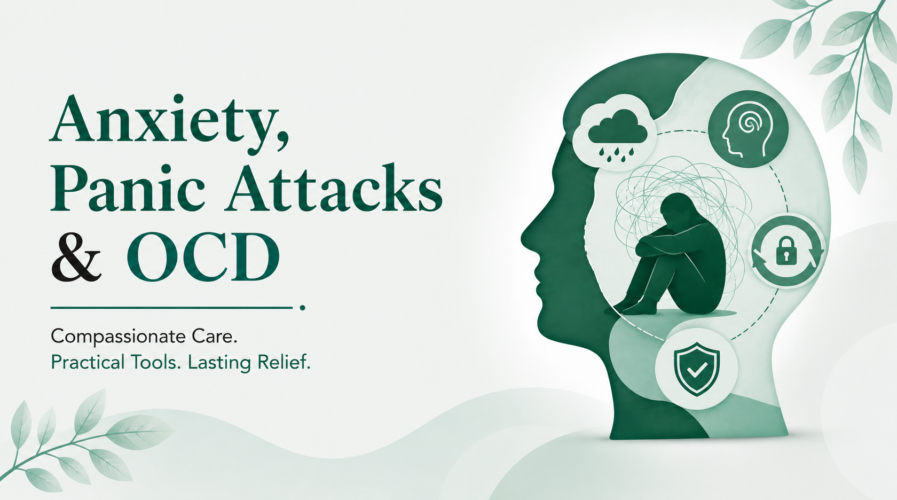
Coping with Anxiety, Panic Attacks, and Obsessive-Compulsive Disorder
Evidence-Based Mental Healthcare Led by Dr. Tejal Kothari | Online Across India
Overlap Between Anxiety, Panic Attacks, and OCD
When you live in a constant state of fear, or are plagued with intrusive thoughts or sudden panic attacks, life can be a journey through an unpredictable storm. Anxiety, panic attacks, and obsessive-compulsive disorder (OCD) are separate clinical experiences, but they frequently overlap, interact with one another, or co-occur.
The first step to taking back control, overcoming self-doubt, and creating lasting emotional regulation is understanding how these conditions work and how they interact.
What is Obsessive–Compulsive Disorder (OCD)?
OCD is a neurodevelopmental and clinical disorder that involves a cycle of intrusive thoughts and repetitive behaviors:
- Obsessions: Distressful, anxiety-provoking or uncomfortable repetitive, intrusive, unwanted thoughts, images, or urges. Common themes are fears of contamination, harm to oneself or to loved ones, taboo intrusive thoughts, or a need for symmetry and exactness.
- Compulsions: Physical acts or mental rituals that people perform to reduce the distress of obsessions or to prevent a feared event. Examples include excessive checking, washing, counting, seeking reassurance, or repetition of mental phrases.
The Cycle of OCD
Obsessions generate anxiety and this generates an urgent need to do a compulsion. Compulsions may offer short-term relief, but they reinforce the brain’s mistaken belief that the threat was real, trapping you in a repeating cycle.
What is Panic Disorder and Panic Attacks?
A panic attack is a sudden period of intense fear or discomfort that peaks within minutes. During this time severe physical reactions occur. It’s marked by debilitating physical and mental symptoms that activate the body’s natural alarm system to “fight or flight” even in the absence of real physical danger.
Symptoms of a Panic Attack
- Fast or pounding heart beat (palpitations)
- Breathlessness or feeling of suffocation
- Chest pain, pressure, or tightness
- Faintness, dizziness, or lightheadedness
- Sweaty, shaky, trembling
- Tingling or numbness (paresthesias)
- Derealisation or Depersonalisation (feeling cut off from reality or from yourself)
- Afraid to death to lose it, go crazy, or die
Panic Disorder is when a person has recurrent panic attacks which are unexpected and cause the person to worry about having more panic attacks or change their behavior to avoid possible triggers.
OCD & Panic Attacks: What is the Connection?
OCD and Panic Disorder are different diagnoses, but they share two main areas in common:
1. Panic Attack Due to OCD
If obsessive thoughts are high or overwhelming, then the emotional spike can tip over into a full panic attack.
Clinical Example: Someone with “Harm OCD” may have an intrusive, random mental image of harming someone they love. The intrusiveness of the thought can be so horrific and panic-inducing that it can cause hyperventilation, racing heart, and extreme lightheadedness, sending them running from the room to avoid some imagined harm.
2. Co-Occurrence Without Independence
A person can have OCD and Panic Disorder as separate, but coexisting disorders. This could be due to general nervous system dysregulation, or anxiety sensitivity, but neither disorder causes the other.
Evidence-Based Treatments
Effective treatment requires tailored approaches to therapy and medical care that break the cycles of fear, avoidance, and ritualization.
1. Cognitive Behavior Therapy (CBT)
CBT focuses on the connection between thoughts, feelings, and behaviors. It provides practical tools to identify unhelpful thought patterns, reduce avoidance, and change behavioural responses to anxiety.
2. Exposure and Response Prevention (ERP)
Treatment of choice for OCD, ERP means gradually and safely exposing yourself to what you obsess about, be it thoughts, objects, or situations, and being encouraged to fight the urge to do compulsions. Over time, your nervous system figures out that the anxiety will subside on its own, without the need for the rituals.
3. Medical Management
Where appropriate, evidence-based pharmacotherapy such as Selective Serotonin Reuptake Inhibitors (SSRIs) may also help to regularise neurochemistry, reduce the baseline severity of intrusive thoughts, and reduce the frequency of panic surges.
Panic Grounding and Stabilization Techniques
Short-term grounding tools can help stabilize your nervous system during an acute surge of panic while comprehensive treatment addresses root causes:
5-4-3-2-1 Grounding Technique
Notice things around you to distract you from the internal physical signs of alarm and anchor you to the present moment:
- 5 things you can SEE: A clock, a pen, a light fixture, your shoes, or a window.
- 4 things you can TOUCH: The feel of your chair, your clothes, a desk, or cool water.
- 3 things you can HEAR: Traffic, an air conditioner, voices far away, or your breathing.
- 2 things you can SMELL: Coffee, fresh air, soap, or essential oils.
- 1 thing you can TASTE: A mint, water, or the current taste in your mouth.
Diaphragmatic (Belly) Breaths
Panic breathing is fast breathing. This drops carbon dioxide levels and makes symptoms like dizziness and tingling worse. Slow your breathing to activate your body’s parasympathetic “rest-and-digest” response. Inhale deeply into your abdomen for 4 seconds, hold for 2 seconds, and exhale slowly for 6 seconds.
FAQ (FREQUENTLY ASKED QUESTIONS)
Anxiety in general is characterized by the continuous rational ruminations about real-life problems such as money, health, or work. OCD obsessions are usually intrusive, bizarre, or extreme thoughts (often conflicting with the core values of the person having them) and which cannot be dismissed without performing a ritual or mental compulsion to neutralize them.
Nope. Panic attacks can be scary and mimic serious medical emergencies such as heart attacks. But, they are an activation of your body’s natural survival mechanism (fight-or-flight). They don’t cause heart attacks or brain damage or sudden collapse, and the physical symptoms diminish as your nervous system recalibrates.
Having a panic attack in isolation during a stressful period does not mean you have Panic Disorder. People with Panic Disorder have repeated and unexpected panic attacks. They also have a persistent fear of having panic attacks or change their behavior significantly to avoid having panic attacks.
Yes. Video-based ERP/CBT therapy sessions and telehealth consultations that are clinically proven are just as effective as in-person therapy for adult anxiety, panic, and OCD. Online treatment of these conditions also allows you to practice grounding and exposure exercises in your real home environment.
Medication (such as SSRIs) helps decrease the severity and frequency of symptoms and makes it easier to function and participate in therapy. But, medication works best when used with proven psychotherapies (like CBT or ERP) that teach coping skills (behavioral and cognitive) for long-term use.
Take the First Step to Clarity & Calm
You don’t have to do this alone in the exhausting cycle of panic, intrusive thoughts, and anxiety. You can reclaim your confidence and peace of mind through professional assessment and neuro-affirmative, evidence-based care.
Are you ready to begin your journey?
Schedule your consultation with Dr. Tejal Kothari today | Ask about assessment options