
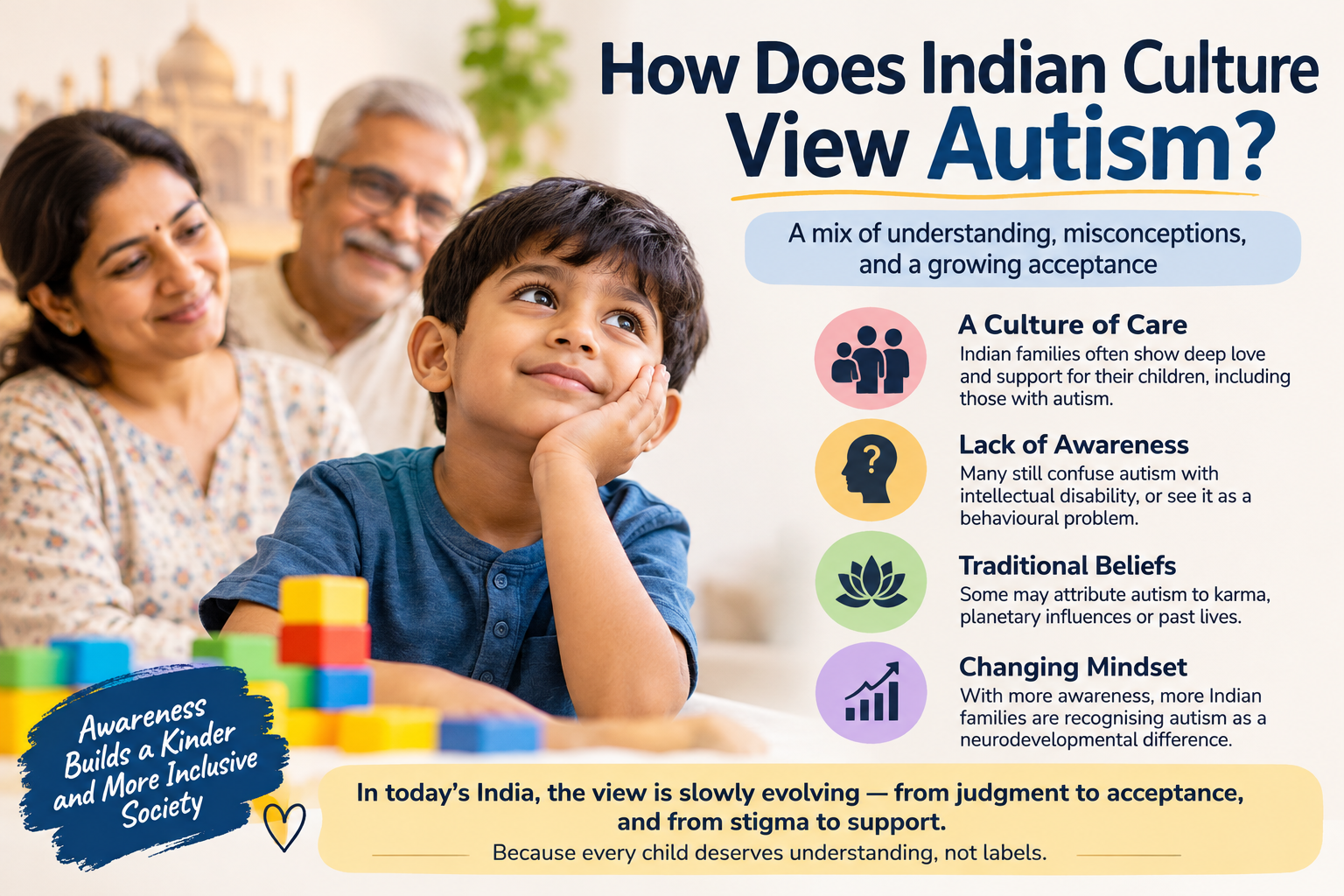
In many parts of India, autism is misunderstood even today. Awareness is slowly growing especially through social media and information on the internet but many families still have a hard time understanding what autism actually is. In many communities, developmental differences are overlooked, attributed to fate or religious beliefs, or are considered something families should conceal from society.
One of the biggest challenges in India, in my observation, is not just the lack of autism awareness but how society reacts to the child who develops differently.
Some parents believe that eventually their child will be like the other kids. Others are told by relatives to wait, perform religious rituals or try traditional remedies. Unfortunately, these beliefs can sometimes get in the way of professional assessment and the right support.
Understanding the Indian cultural conceptualisation of autism requires moving beyond medical definitions and looking at the role of family expectations, education, religion, social pressure and traditional beliefs.
1. Absence of autism awareness in Indian society
One of the biggest challenges in India is the absence of basic awareness about autism and child development.
I have seen many educated people who don’t know enough about autism to spot early signs. One reason is that the mainstream school education pays little attention to the basic psychological and developmental education. Kids can go through school and not know much about developmental conditions like autism.
This means that parents may not immediately think of a developmental concern when they see their child not communicating, interacting, or responding in the same way as other children the same age.
Some typical reactions include:
- The time will come when the child will speak.
- Boys do talk late. so don’t worry.
- There is no need to consult anyone as each child develops differently.
- The child is just quiet or does not like to socialise with people.
Social media, parenting communities and online health information are raising awareness. But still, there is unequal access to reliable information and professional advice.
In big cities like Delhi, Mumbai, Pune, Goa and Noida some families are more exposed to psychiatrists, developmental specialists and services for autism. This does not imply, however, that all urban families are well informed.
In many rural communities there may be less awareness and access to specialists. This creates a gap between knowing about development concerns and seeking professional help.
2. Why do some families in India believe that autism is due to fate and religion?
Traditional beliefs and religious practices hold a big place in many Indian families. Religion can provide emotional strength and comfort in difficult times. But problems arise when religious explanations take the place of medical understanding.
In some communities, parents might view a child’s developmental differences as something associated with fate, destiny or God’s will.
You might hear something like:
- His fate says so.
- With time everything will be normal.
- Perform a particular puja and everything will be okay.
- Take the child to someone who can do jhaad-phoonk or traditional healing.
For instance, in some families, if a child learns to talk late, they will say that the child will walk early. Similarly, if a child walks late, they may think that the child will talk early.
Yet these assumptions are traditional and not reliable ways of understanding child development. All children develop at different rates and a delay in one area of development should not be used to predict a delay in another.
Autism is a developmental disorder of the brain. You can’t diagnose or understand it with religious beliefs, astrology or traditional assumptions.
Families are free to follow their religious beliefs but these should never replace a professional assessment or evidence based support.
3. Why do parents hide their child’s autism diagnosis?
Family reputation and social acceptance can be of huge importance in Indian society. This can make parents feel uncomfortable discussing their child being diagnosed with autism.
Some parents worry that if relatives, neighbours or people in their community know about the diagnosis, their child may be bullied, discriminated against or unfairly judged.
There are also concerns about the future of the child in relation to friendships, education, employment and prospects of marriage.
This fear can cause families to hide the diagnosis instead of actively seeking help.
I think that sometimes parents are more worried about how society will treat their child, than they are about how to explain their child’s developmental needs to others.
This causes another problem. When families conceal developmental concerns, they may also avoid discussing them with teachers, relatives or professionals who could help the child.
An autism diagnosis is not a failure for the family or something to be ashamed of. It is information that can help parents understand their child’s needs and seek appropriate support.
4. Commonly Believed Myths about Autism by Indian Parents
Traditional beliefs and incomplete information can lead to false beliefs about autism.
Let’s get acquainted with some of them common ones.
Myth 1: Boys are usually later speakers
Many Indian families believe that boys are late talkers compared to girls.
Boys may be slower than girls to develop language, but a serious delay in communication should never be dismissed as “a boy thing.”
Parents should know developmental milestones, attempts to communicate, social interaction and other signs of development.
Myth 2: The Child Will Become Normal Overtime
This is another widespread belief.
Other parents choose to wait, hoping the child will eventually start to talk and interact and act like other kids.
But autism is not a temporary lag that every child grows out of.
Early identification can help families understand their child’s strengths and difficulties and access appropriate developmental support.
Without professional guidance, waiting may mean missing valuable opportunities for early intervention.
Myth 3: Cell Phones Cause Autism
The use of smartphones is common in Indian households, and this misconception needs special attention.
A lot of parents hand out smartphones to young kids to keep them occupied while they work, cook or handle other responsibilities.
Kids spend a lot of time watching cartoons, rhymes and colourful videos rather than talking to people around them.
From a developmental point of view, children need to have the opportunity to communicate, to see facial expressions, to respond to people, to play and interact with their environment.
Excessive screen time may reduce opportunities for these important interactions, and may be linked to language and communication difficulties.
But it is important to know the scientific distinction: screen time is not an established cause of autism. Autism has complex developmental and genetic factors. Studies have found no evidence that watching cartoons or using mobile phones causes autism.
Parents should still be establishing healthy screen habits and spending meaningful time talking, playing and interacting with their children.
Instead of always using a phone to play nursery rhymes, parents can sing nursery rhymes, repeat words, show objects, ask simple questions and encourage the child to respond.
Myth 4: Bad parenting causes autism
There are families who blame the parents, especially the mothers, when a child is diagnosed with autism.
But autism is not caused by lack of parental love, attention or discipline.
Parenting practices cannot be blamed for a child’s autism. Parents influence the child’s environment, learning opportunities, communication experiences, and access to appropriate support.
Encourage parents to understand their child’s needs instead of spending time on self-blame.
Myth 5: Treating Autism With Traditional Remedies
Some families resort to spiritual healers, traditional practitioners or religious remedies believing that these methods can resolve developmental problems.
Although religious practices may provide emotional comfort, scientific evidence has not demonstrated them to be a treatment for autism.
Families should not wait for professional assessment or evidence-based interventions while trying untried remedies.”
5. Why Indian Mothers Are Blamed More When A Child Is Autistic
In many Indian homes, when a child has developmental difficulties, it is the mothers who end up shouldering a disproportionate burden.
People may ask about how the mother raised the child, whether she paid enough attention or if she made mistakes during pregnancy or early childhood.
This speaks to a larger social problem in which the burden of child care is often placed on women.
The mother is not the sole responsible for the child’s development.
Fathers, grandparents and other family members too have an important role to play in providing a supportive environment.
In the traditional Indian household, it was a joint family system and many members took part in bringing up a child. Smaller nuclear families and working parents today may not have as many people to share these responsibilities.
Some parents use mobile phones to entertain their children when they do work and household chores. If it becomes a routine substitute for direct engagement, it can reduce opportunities for interaction.
But it would be a mistake to think that nuclear families or working parents are to blame for autism. Autistic children can be found in all kinds of families.
What matters is that parents and carers have the correct information, support and opportunities to engage with their children.
Indian families need to move toward collective responsibility and understanding, not blaming mothers.
6. Why is early detection of autism important?
One of the most common mistakes families make is to ignore developmental signs, believing the child will catch up eventually.
Autism can affect different children in different ways. Not every autistic child will share the same characteristics or need the same amount of help.
Signs parents might see include:
- Speech Delay or Other Communication Problems.
- Not much eye contact or any other social interaction.Not always answering when you call their name.
- Repetition of motion or activity.
- Extreme sensitivity to certain sounds, lights, textures.
- Trouble with changes in routine.
- Restricted interest in specific types of social interaction.
These signs don’t necessarily mean a child has autism. They may also be present in some other developmental disorders.
You need to have a proper professional assessment to understand what is happening.
Parents who notice developmental concerns should get advice from an appropriate professional like a developmental paediatrician or child and adolescent psychiatrist. Support will be based on the needs assessment of the child and could include clinical psychologists, speech and language therapists, occupational therapists and other specialists.
Early intervention can help with communication, social interaction, learning and everyday living.
The Indian Academy of Paediatrics also recommends that appropriate intervention be initiated at the earliest and care be tailored to the developmental needs of the child.
7. How can we make Indian families more accepting of autism?
Shouting out information on World Autism Awareness Day is not sufficient to change social attitudes.
Families, schools, health professionals and communities all have a role to play.
Here are some key steps:
1. Raise awareness from an early age
Schools should offer age-appropriate education on child development, psychological well-being and neurodevelopmental conditions.
2. Stop Comparing Kids
Every child is following a personal developmental pathway. Parents should not brush aside concerns by comparing their child to siblings, cousins or neighbours.
3. Promote seeking professional advice
‘Parents who notice developmental differences should seek professional advice and not solely rely on the advice of relatives or neighbours.
4. Blame not the parents, support them
Families need to be understood and given practical support. Putting the blame on mothers or questioning parenting choices only adds to the stress.
5. Build an inclusive environment
Schools, neighbourhoods and social communities should value autistic children. Bullying, discrimination and social exclusion must not be tolerated.
6. Use social media responsibly.
Social media can be a great way to raise awareness about autism, but families should turn to qualified professionals and reliable medical information, not videos with no proof behind them or miracle-treatment claims.
Conclusion: More Understanding, Less Judgement for Indian Society
Family, relationships, traditions and social acceptance are highly valued in India. When used positively by families, these values can be a powerful source of support for autistic children.
But families might also be held back from recognising developmental concerns by traditional beliefs, fear of social judgement and lack of awareness.
I think the first step toward better autism awareness in India is to make the parents realise that developmental differences cannot be ignored or attributed to fate alone.
An autistic child does not need to be hidden away from society or to be constantly compared with other children. The child needs understanding, acceptance, appropriate help from professionals and a supportive environment.
Parents should not wait for relatives to approve or for society to understand if they see signs of developmental differences. The right guidance at the right time can make a huge difference to the developmental journey of the child.
There is nothing to be ashamed of about autism. It’s a lack of awareness and a failure to provide support that is the problem.





Comments (0)